Tell me and I forget, teach me and I may remember, involve me and I learn.”— Benjamin Franklin
Our methodology of Storytelling combined with hands-on activities ensures that children not only learn but also enjoy and retain scientific concepts
Our books focus on fewer topics and provide more in-depth coverage of the concepts. “Buzz – the hard working bee” features a bee named Buzz, and a fictionalized account of young kids who want to find out why all the food and bees have disappeared. They learn about the features and importance of bees in food production and how environment affects their survival. Thus they are introduced to the concept of food security, pollution, biodiversity and functions of bees. This is unlike a nonfiction book detailing the causes and effects of the deteriorating environment.
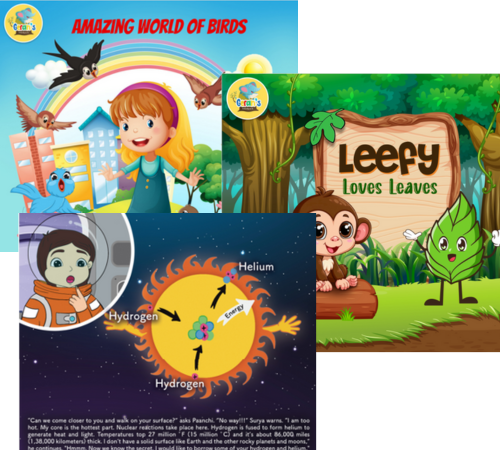
Our books help children to observe and infer. For instance, in “Amazing world of birds”, the character Chirpy, visits her grandmother, feeds the birds, observes them and infers that the beak shapes are correlated to their feeding habits.
In the books, “Leefy loves leaves” and “Leefy and Greeno”, the conversation between a little chimp, Leefy and his leaf friend, Greeno can assist the kids in learning about the importance and functions of leaves.
Our books encourage discussions. We aim for children to actively engage with the story rather than merely absorbing it passively. It's crucial to stimulate their thinking about the narrative. While teachers can pose guiding questions to foster this reflection, we also want students to independently generate inquiries. For instance, children might wonder and inquire if walking on the sun is possible in the book “Sun-our mighty friend” alongside Paanchi
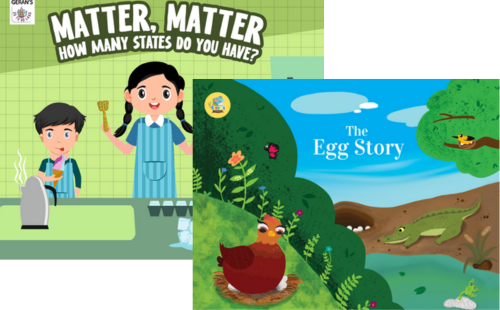
Our books captivate readers and can ignite curiosity about scientific subjects, guiding students towards informational texts to explore questions raised by the narrative. For instance, "The egg story" employs the tale and the character of Migi, a tiny hen, to attract students' attention and involve them in questioning about animals that lay eggs
In science education, inquiry encompasses not only research for information but also hands-on experiments. For instance, the book “Matter matter how many forms you have” employs a narrative to guide students in exploring solids, liquids, and gases through activities.